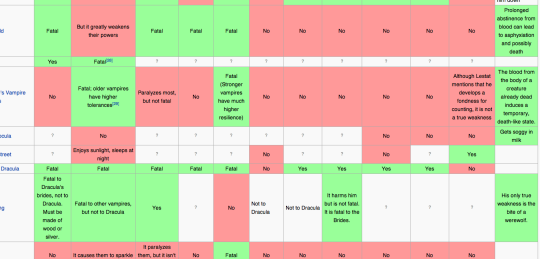
so im trying to decipher this chart on wikipedia that has common vampire weaknesses in it and
a ‘green/yes’ is a weakness, a ‘red/no’ is something that isnt a weakness, and a ‘?’ is something that has never been addressed but fucking riddle me this
in what lore are vampires weak to getting soggy in milk
i scrolled over to check to see what this could possibly be and
places a hand on me cheek
happy halloween month time for my favourite post of all time
you know, I think about the subtleties of this term a lot, because it’s inherently a term related to assumptions and prejudgements about your audience (namely: how familiar are they with the subject I want to talk about) and because a certain amount of best guesses are inherent to general conversation.
‘Mansplaining’ is *not* just ‘a man explained a thing to a woman’ or even ‘a man misjudged his audience.’
Mansplaining is a term that arises because men are especially likely to assume women are less informed on topics then they themselves are, especially traditionally ‘male’ topics. And as a woman it is frustrating and belittling to encounter these assumptions at high frequency.
On the other hand, people in general love to explain their topics of interest to other people.
How do balance these things in the fly?
Well. This is a actually challenge I encounter a *lot*, but in a largely non-gendered context, in academia. Because at conferences and other scientist-frequented gatherings we are *constantly* talking about stuff we are excited about that needs explaining, and we are *constantly* thrown into situations where we have to rapidly assess the other person’s level of familiarity with the subject. Academia is a whole damn world of niche specialities with unpredictable overlaps.
Do you know how embarassing it is to be talking about a paper you vaguely remember and realize later that you were talking to the world expert in that field? Because I have had that experience. More than once. And you’re left frantically trying to remember if you said anything particularly stupid or presumptive.
On the other hand, do you know how useless it is to the other person if they ask about your work and you jump in about three levels able their head and don’t even bother to lay the groundwork about why this topic is broadly relevant or interesting? That’s just bad science communication.
I think this chart nails the number one rule for approaching this problem: did you ask? are you checking in to see where comprehension is with your audience and to assess their engagement and knowledge?
One of the first things I teach students for practicing their on-the-fly ‘elevator pitches’ about their research is to build in these check ins. “I don’t know how familiar you are with ant biology…?” “Have you heard about that new stuff with gut bacteria affecting human health and behavior?” “Have you ever known anyone with Parkinson’s?”
And this holds true at *every level* of science communication: whether you’re talking to the judge that stopped by your poster and trying to affirm their familiarity with your particular subject area, whether you’re teaching a new class of students and have no idea how solid their background is on a topic and what’s going to bore them vs what’s going to lose them. Or maybe it’s your friend’s neighbor’s mom, asking what kind of science you do, and you really are blind to their history with the topic.
‘Mansplaining’ exists as gendered term because there is a *pattern* of this occurring based around gendered dynamics, but the wider phenomenon of misjudging your audience is something that *everybody* has to learn how to tackle at some point in their life.
Don’t assume! Check in! Keep checking in! It’s not a lecture, it’s a conversation, and that means interaction.
Ooh, reblogging again for really good points – I’ve definitely felt like an ass for going on about cool stuff I encountered in Japan only to find that the person I was talking to had been going there in the summers for years & already knew most of what I was saying :P. Having a built in, habitual check in when you’re talking about stuff that isn’t common knowledge is a great way to avoid that in general.
Thinking about this a little more—
context and tone are important, too. people are a lot more forgivingly indulgent of ‘excited sharing’ than of ‘condescending correction.’
and frankly, even in situations where you *do* know more than the other party, people just enjoy being invited to share your excitement on topic much more than they enjoy the sense of being used as Correct Information Receptacles. my students engage way more when I share than when I inform.
I have a general talk I’ve given a few times now on, more or less, “how life goes about existing in some Very Weird places”, and whenever I’m asked to give it again my first question is always “who is my audience?”. Because I’ve given it to everybody from other scientists (who are not biologists) to people who just happen to be in the room, and while it’s a lot harder to adapt on the fly in an actual lecture rather than a conversation, you cannot give a good talk of any sort without knowing who your audience is. Otherwise you’re just enjoying the sound of your own voice.



 Spitfire Alice A Gra
You must be logged in to post a comment.